ADHD Decision Paralysis: How to Pick What to Do Right Now
A 5-step method to beat ADHD decision paralysis: brain dump, pick top 3, break tasks into tiny steps, set a 60-second choice and a 5-minute start.
ADHD decision paralysis happens when you're overwhelmed by too many choices or tasks, leaving you stuck and unable to act. It's not about laziness - it's a brain overload tied to challenges with executive function and lower dopamine levels. This can make even small decisions feel impossible.
Here’s a quick solution:
-
Brain Dump: Write down everything on your mind.
-
Top 3 Tasks: Choose three priorities based on urgency and importance.
-
Break It Down: Split tasks into tiny, actionable steps.
-
60-Second Timer: Decide what to start within a minute.
-
5-Minute Rule: Commit to just five minutes of work to build momentum.
Tools like Onsara, TickTick, or Amazing Marvin can simplify decision-making. Focus aids like timers or body doubling also help. The key? Start small and take action, even when it feels hard.
Understanding ADHD Decision Paralysis & How To Stop It | Episode 267
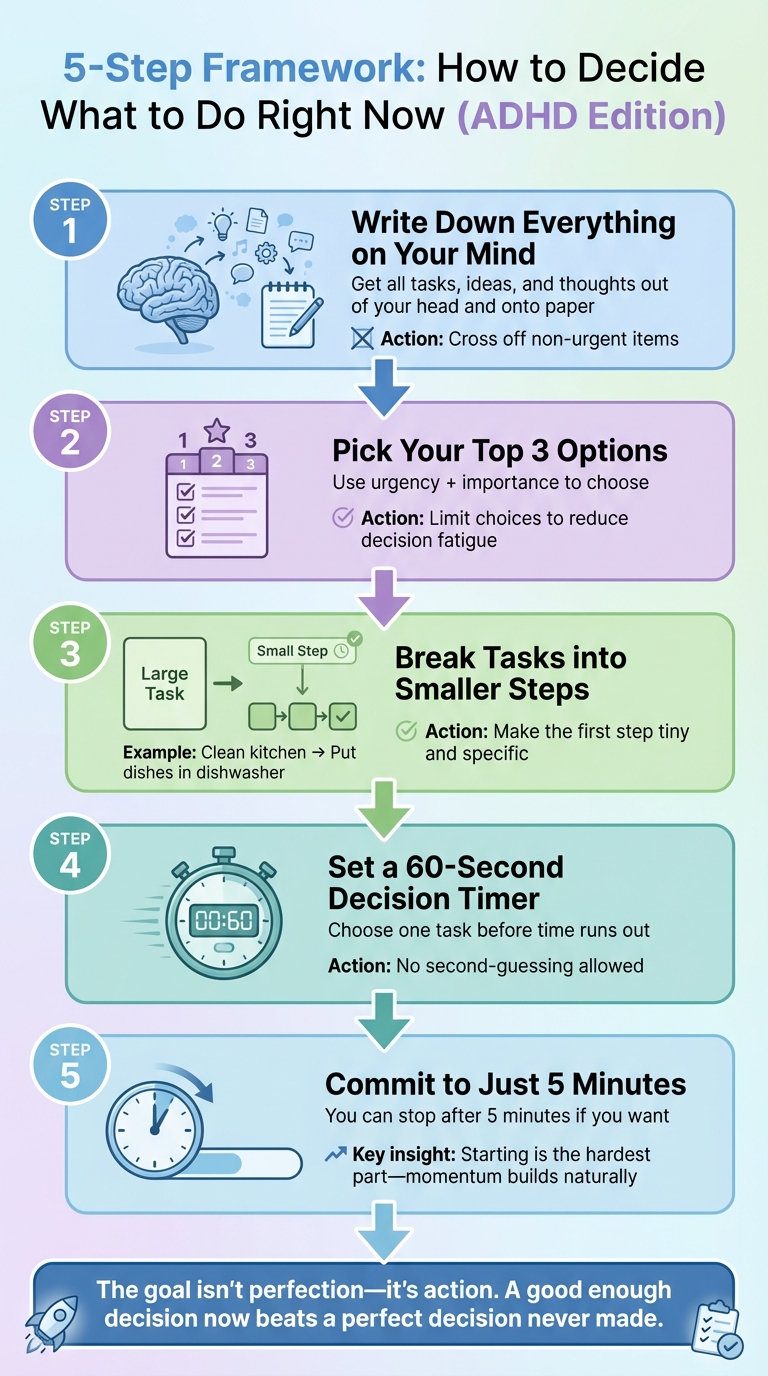
A 5-Step Framework for Deciding What to Do Right Now
If ADHD decision paralysis has you stuck, this five-step process can help you choose and take action right away.
Step 1: Write Down Everything on Your Mind
Start with a brain dump - write down every task, idea, and thought swirling in your head. Don’t overthink it; just get it all out on paper.
This step helps reduce mental clutter. When your mind is juggling too many thoughts, it’s easy to feel overwhelmed. But seeing everything laid out in front of you makes it easier to focus and prioritize.
"Externalizing thoughts cuts through the clutter of competing thoughts." - ADDitude Editors [4]
Once your list is complete, review it carefully. Cross off anything that isn’t urgent or necessary right now. You’ll likely find that some tasks lose their sense of urgency once they’re written down. For vague or intimidating tasks, break them into smaller, actionable steps. For example, instead of writing “Write essay,” try “Find three sources” or “Draft an outline.” Smaller steps feel more manageable and less overwhelming.
With a refined list, you’re ready to narrow your focus.
Step 2: Pick Your Top 3 Options
From your list, choose three tasks to focus on. Limiting your options helps reduce decision fatigue.
Use simple criteria like urgency and importance to guide your choices. The Eisenhower Matrix can be a helpful tool for sorting tasks into categories based on what’s pressing and what matters most. If you’re still unsure, look for quick wins - smaller tasks you can finish easily to build momentum.
ADHD coach Caren Magill warns against a common pitfall:
"ADHDers tend to be additive. When overwhelmed by too many tasks, our instinct is to buy a new planner or productivity system - adding more complexity rather than simplifying." [5]
Instead of complicating things with new tools or ideas, focus on simplifying. If a task feels more like chasing a shiny new opportunity than solving a real problem, move it to a “parking lot” list to revisit later. Many spur-of-the-moment ideas lose their appeal within a couple of days anyway.
Step 3: Break Tasks into Smaller Steps
Take your top three tasks and break each one into the smallest possible first step. For example:
-
Instead of “Clean the kitchen,” write “Put dishes in the dishwasher.”
-
Instead of “Start project,” write “Open the document and write one sentence.”
When tasks are vague or too large, they can feel paralyzing. Breaking them into tiny, specific actions makes them easier to start and reduces the mental resistance that often keeps you stuck.
With your tasks broken down, it’s time to decide what to tackle first.
Step 4: Set a 60-Second Decision Timer
Stop overthinking and make a quick decision. Set a timer for 30 to 60 seconds and choose one task before the timer runs out. Whatever you pick when time’s up is the task you’ll start - no second-guessing allowed.
This approach helps cut through analysis paralysis. ADHD brains often struggle with sorting through too much information, but they tend to respond well to quick, time-limited decisions.
Using a physical timer or a countdown app can make this process feel more real and help combat time blindness.
Step 5: Commit to Just 5 Minutes
Once you’ve chosen a task, promise yourself you’ll work on it for just five minutes. Remind yourself that you can stop after five minutes if you want to.
This small commitment feels manageable and helps lower the resistance to starting. Often, getting started is the hardest part. Once you begin, you’ll likely find it easier to keep going as momentum builds naturally.
"It's about making a good enough decision within a reasonable timeframe, rather than searching for the perfect one indefinitely." - Adam Brownfeld, PhD [3]
The goal here isn’t to be perfect - it’s to take action. By following this framework, you can move from feeling stuck to making progress, one small step at a time.
Tools and Apps That Help You Decide
Using the 5-step framework becomes even easier when paired with the right tools. These apps and resources bring structure to your decision-making process, cutting through mental clutter and helping you stay focused when you're feeling overwhelmed.
Onsara by Artisan Strategies
Onsara is a macOS app designed to simplify the "what should I do next?" dilemma. Instead of adding yet another to-do list, it uses AI to analyze your tasks and recommend the next step. This is especially helpful if you’re stuck in that frustrating "I have 50 things to do and can’t pick one" loop. By applying cognitive task analysis, Onsara makes choosing your next task more straightforward and less stressful.
Task Management Apps for ADHD
Some apps act like a personal assistant, helping you offload mental tasks and reduce the number of decisions you face each day.
"Effective tools work like a well-designed executive assistant – they anticipate your needs, reduce the number of decisions you have to make, and provide information exactly when and how you need it." - Tandem Coach [6]
Here are a few standout options:
-
TickTick (Premium: $35.99/year): Incorporates the Eisenhower Matrix, allowing you to visually sort tasks by urgency and importance.
-
Amazing Marvin ($12/month or $96/year): Offers a "Task Jar" feature that picks a random task for you, perfect for breaking through decision paralysis.
-
Goblin Tools (free web version, ~$1.99 for mobile): Uses AI to break vague tasks into smaller, actionable steps.
Before adopting a new tool, ask yourself: What problem is this solving? Will it work with my current setup? Can I see its value within a week? Most importantly, does it make your day simpler or more complicated? [6]
In addition to task management apps, timers and focus aids can help you stay on track.
Timers and Focus Tools
Visual timers are great for combating time blindness by making time feel more concrete. Countdown timers are especially useful for quick decision-making techniques, like the 60-second rule. Apps such as TickTick also include Pomodoro timers, which are ideal for structured work sessions.
For extra accountability, platforms like Focusmate (3 free sessions per month, unlimited for $6.99/month) pair you with a virtual coworker to work alongside. This simple form of "body doubling" can make starting tasks much easier. In fact, research suggests body doubling can boost productivity by up to 40% [7].
Physical timers with visual countdowns or color-coded displays are another option. They’re perfect for short, focused intervals, such as using the five-minute rule to jumpstart a task.
How to Reduce Overwhelm When It Hits
When decision paralysis takes over, it can feel like your brain is stuck in neutral. The good news? There are ways to dial down the overwhelm and get back on track, especially if you take an ADHD-friendly approach.
Limit Your Options
Having too many choices can lead to what researchers call the "paradox of choice" - where more options actually make decisions harder, sometimes resulting in complete mental shutdown [1][2]. To counter this, start by narrowing your focus and cutting out options that don’t meet your needs.
"Did you know the word 'decide' comes from the Latin word 'to cut off?' Limit your choices." – ADDitude Editors [4]
A simple trick is the Two-Option Rule: instead of juggling endless possibilities, pick two realistic tasks and choose between them [3]. This keeps things manageable without dismissing other possibilities entirely.
Another helpful tool is the Eisenhower Matrix, which sorts tasks into four categories: Urgent/Important, Important/Not Urgent, Urgent/Not Important, and Neither [2][9]. This method naturally spotlights what deserves your attention most.
Sometimes, it’s okay to go with a "good enough" decision rather than striving for perfection [3]. Limiting your options isn’t about settling - it’s about keeping the momentum going.
Once you’ve pared down your choices, setting up clear defaults can help you maintain that forward motion.
Set Up Routines and Defaults
Every decision takes a toll on your mental energy [10][13]. For those with ADHD, this can quickly lead to decision fatigue [2][9]. The idea of "deciding once" for recurring situations can help conserve your energy.
"The goal of deciding once isn't about rigidity - it's about creating ease." – Suzy Carbrey [10]
Defaults can be as simple as a capsule wardrobe, themed dinners, or automated bill payments [10][13]. At work, consider scheduling deep-focus blocks at the same time daily and setting fixed times to check email - say, at 10:00 AM and 3:00 PM [10].
Start small. Identify one daily stress point and create a default solution for it [12]. Even something as basic as buying identical socks to avoid mismatching can make mornings run more smoothly [10][11][13].
Change Your Environment
Your physical surroundings can either help or hinder your ability to manage overwhelm. For individuals with ADHD, distractions like noise and visual clutter can make focusing - and decision-making - much harder [9][4].
"Noise, visual clutter, and too much hustle-bustle overload an ADHD brain, making it hard to make a decision." – ADDitude Editors [4]
Start by tidying up your workspace. A clean, quiet area - or a designated "decision zone" - can minimize distractions [4]. Writing out your options on sticky notes or a whiteboard can also make them feel more tangible and easier to evaluate [3][4].
If you’re feeling stuck, switch up your scenery. Move to a different room, visit a café, or take a quick walk. Physical movement and a change of environment can help clear your mind and reset your focus [1][3].
Another strategy is body doubling - working alongside someone else, whether in person or virtually. Their presence can provide accountability and make starting tasks less daunting [1].
If digital distractions are an issue, try focus tools like a Pomodoro timer (25 minutes of focused work followed by a 5-minute break) or browser extensions that block distracting websites during work sessions [8][9]. Even small tweaks to your environment can make a noticeable difference.
Conclusion: Start Building Your Decision-Making System
What to Remember
Feeling stuck in decision paralysis doesn’t have to define your day. Start small - adopting even one strategy can lead to meaningful change over time. As we’ve covered, adjusting your environment, setting up defaults, and breaking tasks into smaller steps can make decision-making easier and more manageable.
This guide introduced practical tools like brain dumps, quick timers, and micro-step planning to help you take action immediately. Small tweaks, like creating simple defaults for repetitive decisions, can lead to steady progress. Tools such as Onsara by Artisan Strategies offer structured support to help you build a system that works for you.
"Often, a 'good enough' decision made now is far better than the 'perfect' decision that never gets made." – Adam Brownfeld, PhD, Behavioral Health Partners [3]
The goal isn’t perfection - it’s momentum. Accept that not every decision will be flawless, and that’s perfectly okay.
What to Do Next
Now it’s time to put these strategies into action. Start by identifying one recurring stress point in your day - something like picking out clothes in the morning or deciding which task to tackle first at work. Use a simple default or apply the 5-step framework to address it. Track your progress and adjust as needed. Your system will adapt as you figure out what works best for you.
If you feel you need extra guidance, consider working with an ADHD coach or a therapist trained in Cognitive Behavioral Therapy (CBT) or Dialectical Behavior Therapy (DBT) [8][9]. Whether you use a physical timer or an app like Onsara by Artisan Strategies, these tools can help you stay organized and reduce overwhelm, offering ADHD-friendly features to keep you moving forward.
The key takeaway? Just start. Pick one strategy from this guide and try it today - even if it’s just for five minutes. Each small action you take builds momentum and strengthens your decision-making system, helping you overcome ADHD paralysis one step at a time.
FAQs
How can I manage decision paralysis with ADHD and choose what to do next?
Decision paralysis can be a heavy weight, but there are ways to make it less daunting. One effective approach is to limit your options - try narrowing your choices down to two or three. Fewer options can help ease the sense of overwhelm. Another tip? Break tasks into smaller, bite-sized steps so each action feels doable, rather than like a mountain to climb. Setting short time limits with a timer can also push you to make decisions or complete tasks without getting lost in overthinking.
Sometimes, getting your thoughts out of your head can work wonders. Write down your options or talk them through with someone you trust - it’s amazing how clarity can come from saying things out loud. Focus on what’s most urgent or aligns closely with your goals to prioritize effectively. And don’t forget to give yourself a pat on the back - reward yourself for any progress, no matter how small. If the struggle persists and feels too much to handle alone, reaching out to a professional could provide personalized strategies to help you move forward.
What are some helpful tools to make decisions easier for people with ADHD?
If decision-making feels like a constant uphill battle due to ADHD, there are tools that can make the process a lot easier and less stressful. One such tool is the Eisenhower Matrix. This straightforward method helps you sort tasks into four categories: urgent, important, both, or neither. By doing this, you can quickly see what deserves your attention right away and what can wait.
You might also find decision-making or task management apps helpful. These apps are built to guide you step by step - whether it’s breaking tasks into smaller, manageable pieces or setting clear, achievable goals. They’re great for cutting through the mental noise and keeping you focused, making it less likely for indecision to take over.
How can I break down tasks to make them more manageable?
To make tasks feel manageable, break them down into clear, doable steps. Instead of fixating on the entire goal, focus on one small action to get started. For instance, rather than saying, "I need to write a report", begin with something as simple as "turn on my laptop" or "open a blank document." This approach helps you concentrate on what you can do right now and creates momentum as you complete each step.
If a task still feels overwhelming, jot down a quick list of every tiny action it involves. By handling one small piece at a time, even the most intimidating tasks can feel within reach.
Related reading
- The ADHD Brain Dump Method That Actually Gets You Unstuck
- 5 Apps for Reading Buddhist Scripture Daily
- Best Buddhist Apps for Daily Practice in 2025
- Why "Just Start Small" Doesn't Work for ADHD (And What Does)
- Best Apps for ADHD Task Paralysis (Tested 2026)
Useful tools & services
Explore our tools for everyday work
Browse our focus app, PDF reader, and other products to find an option that fits your task.
Browse our productsThese are products built by Artisan Strategies.