The Complete Guide to the Dhammapada: 423 Verses That Changed Buddhism
Timeless Buddhist verses show that thoughts shape suffering and happiness, offering concise daily practices for mindfulness and ethical living.
The Dhammapada is a revered Buddhist text containing 423 verses across 26 chapters. It distills the Buddha's teachings into concise, memorable lines focused on mindfulness, ethical living, and self-discipline. Despite being centuries old, its wisdom remains practical for modern challenges, addressing topics like stress, anger, and personal growth.
Key points:
- Belongs to the Pali Canon, specifically the Khuddaka Nikaya.
- Organized into thematic chapters, such as "The Mind", "Heedfulness", and "The Path."
- Emphasizes mindfulness, karma, and breaking cycles of negativity.
- Offers timeless advice through vivid metaphors and straightforward teachings.
The text's structure and clarity make it accessible to both monks and laypeople, encouraging reflection and daily practice. With verses like "Hatred is never appeased by hatred; by non-hatred alone is hatred appeased", the Dhammapada provides practical guidance for navigating life's challenges. Apps and daily verse practices now help integrate its teachings into everyday life.
The Dhammapada: Teaching of the Buddha (Part 1, 2) by Gil Fronsdal
History and Structure of the Dhammapada
How the Dhammapada Was Compiled
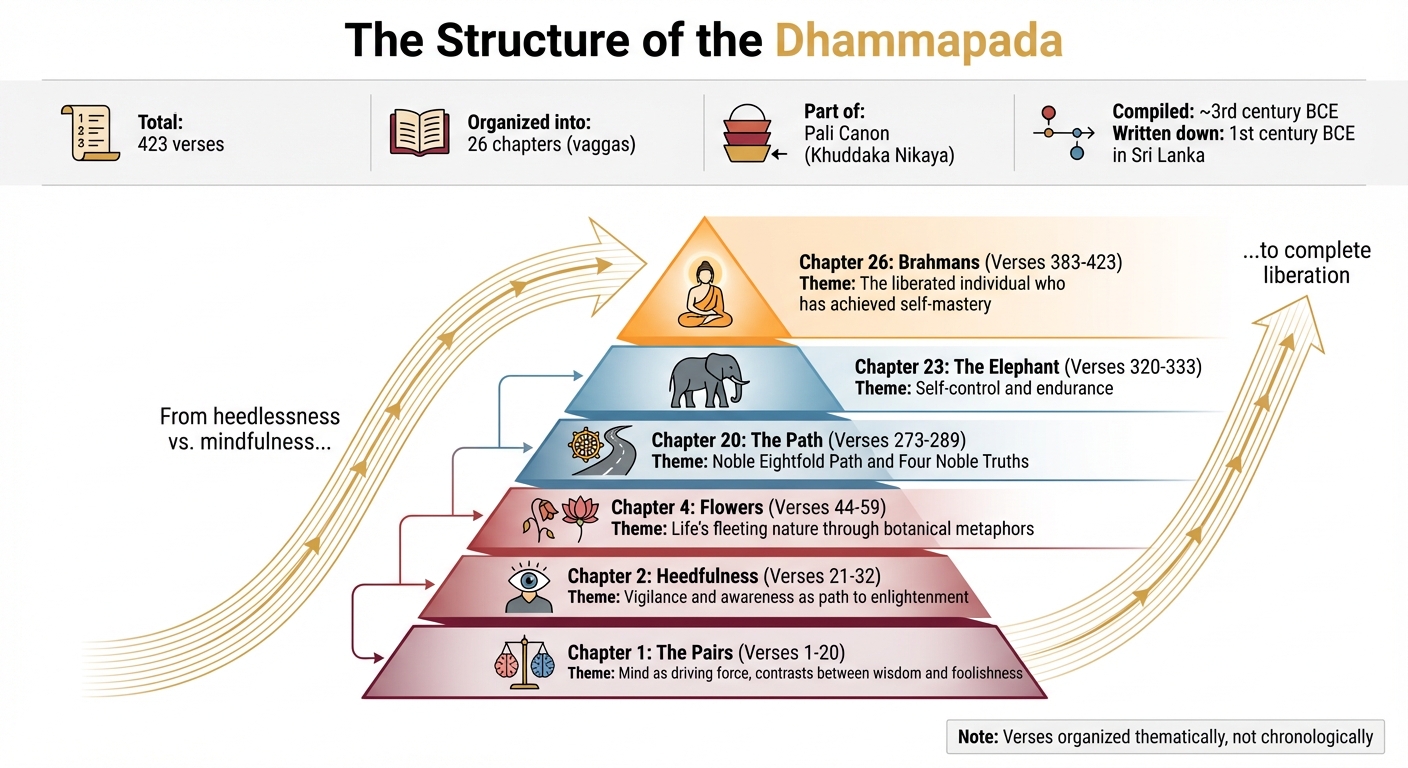
The Dhammapada wasn’t created as a single, unified text. According to the 5th-century scholar Buddhaghosa, each verse was spoken by the Buddha on different occasions, often as responses to specific events or challenges within his community [1]. After the Buddha’s passing, these teachings were preserved orally by specialized reciters known as bhanakas [1].
The text likely assumed its present form around the 3rd century BCE. Its purpose? To make the Buddha’s teachings more approachable for laypeople, expanding their reach beyond the monastic community [1]. The poetic meter of the verses made them easier to memorize and pass down, an essential feature in a time when oral tradition was the primary method of preservation [4]. It wasn’t until the 1st century BCE that the Dhammapada was written down in Sri Lanka. This monumental effort, initiated by King Vattagamani Abhaya, aimed to safeguard the teachings during a period of invasions and famine [5].
Interestingly, some of the verses seem to have been drawn from a broader collection of proverbial sayings common in ancient Indian literature [1]. This blending of sources created a compact anthology of the Buddha’s core teachings. The oral tradition’s meticulous nature ensured the text was organized into distinct thematic chapters, giving it the structure we know today.
The 26 Chapters and Their Themes
The Dhammapada contains 423 verses, neatly arranged into 26 chapters (vaggas), each centered around a specific theme or metaphor [4]. Unlike the longer, more sequential prose found in the Pali Canon, these chapters group verses by shared ideas - ranging from abstract concepts like "The Mind" to vivid imagery such as "The Elephant."
The structure is intentional and symbolic. It opens with Chapter 1 (The Pairs), which introduces the core tension between heedlessness and mindfulness, and concludes with Chapter 26 (Brahmans), celebrating the liberated individual who has achieved mastery over the self [4]. Many chapters use contrasting ideas - such as joy versus suffering or wisdom versus ignorance - to highlight how choices shape our lives.
Some chapters focus on foundational Buddhist principles. For instance, Chapter 2 (Heedfulness) underscores the importance of vigilance as the path to enlightenment, often referred to as the "Deathless." Chapter 20 (The Path) directly explores the Noble Eightfold Path and the Four Noble Truths. Others rely on striking imagery to convey their messages. Chapter 4 (Flowers) uses botanical metaphors to reflect on life’s fleeting nature, while Chapter 23 (The Elephant) likens self-control and perseverance to the power of a trained war elephant.
This thematic and symbolic approach makes the Dhammapada both profound and accessible, offering timeless wisdom through its concise, memorable verses.
Core Teachings from the Dhammapada
Chapter 1: Pairs
This chapter lays out the central idea that the mind is the driving force behind all actions and their consequences. The first 20 verses contrast the disciplined mind of the wise with the careless mind of the fool, using vivid imagery like a well-thatched house versus one that floods. Verse 1 captures this concept clearly:
"Mind precedes all mental states. Mind is their chief; they are all mind-wrought. If with an impure mind a person speaks or acts suffering follows him like the wheel that follows the foot of the ox." [3]
The Buddha uses comparisons to make his teachings relatable - describing a trained mind as a well-thatched house that keeps out the "rain" of passion, while an untrained mind is like an ill-thatched house where unchecked desires flood in. Similarly, the wise remain as steady as a rock, unaffected by praise or blame, while the fool fails to internalize wisdom, no matter how much they hear it.
One of the chapter's key teachings is found in Verse 5:
"Hatred is never appeased by hatred in this world. By non-hatred alone is hatred appeased. This is a law eternal." [3]
This verse highlights the importance of breaking cycles of negativity, a theme that naturally leads to the focus on vigilance in the next chapter.
Chapter 2: Heedfulness
Verses 21–32 emphasize the critical role of attention and awareness. The chapter begins with a striking statement:
"Heedfulness is the path to the Deathless. Heedlessness is the path to death. The heedful die not. The heedless are as if dead already." [3]
Here, "death" refers not to physical demise but to a life lived without awareness. Heedfulness, or appamada, represents sustained effort, discipline, and vigilance, which are essential for true freedom.
Verse 25 offers a particularly vivid metaphor:
"By effort and heedfulness, discipline and self-mastery, let the wise one make for himself an island which no flood can overwhelm." [3]
This "island" symbolizes mindfulness - an inner refuge that shields against external turmoil. The text stresses that simply reciting sacred texts is not enough. Without dedicated practice to overcome lust, hatred, and delusion, true progress cannot be made. The next chapter builds on this, using the metaphor of the elephant to explore the strength that comes from self-control.
Chapter 23: The Elephant
By verse 320, the Dhammapada shifts its focus to endurance and strength. In these 14 verses (320–333), the elephant represents a person who has developed self-control through persistent practice. This individual is steady and unshakable, much like a lotus leaf that water cannot cling to. Even if desires arise, they fail to take hold.
The text acknowledges the difficulty of mastering the mind, likening it to taming a wild elephant. Liberation, it explains, is not about gaining something new but about removing the obstacles - craving, aversion, and ignorance - that cloud perception.
The chapter also showcases the poetic strength of the Dhammapada, with verses like 39 employing intricate linguistic structures to underscore its teachings.
Key Verses and How to Apply Them
Verses That Change Perspective
Some verses have the power to shift how you see everyday challenges. For instance, certain passages use striking imagery to highlight the fleeting nature of the body - describing it as a "city of bones" or a "useless log." While this might sound grim at first, the purpose is far from morbid. Instead, it serves as a reminder to detach from temporary pleasures and develop a sense of urgency for spiritual growth, also known as samvega.
Take Verse 165, which emphasizes personal responsibility: "Purity and impurity depend on oneself. No one can purify another." This verse underscores that spiritual progress is an internal process. No external rituals or guidance from others can replace your own effort and commitment.
Another powerful teaching comes from Verse 348: "Let go of the past, let go of the future, let go of the middle." This isn't about abandoning your duties but about releasing mental attachments to what has been or what might come. By doing so, you create room to fully engage with the present moment.
These verses are not just philosophical musings; they offer practical wisdom that can be woven into daily life to cultivate mindfulness and awareness.
Building a Daily Practice
These teachings aren't meant to stay on the page - they're tools for everyday mindfulness. A great way to integrate them is to focus on one verse each morning. Write it down or reflect on it throughout the day. As Thanissaro Bhikkhu suggests, treat the verse like a "spiritual friend" (kalyanamitta), offering guidance when you're faced with challenges.
For example, when dealing with conflict, recall the earlier teaching on non-hatred. Verse 134 introduces the "broken bell" approach: if someone speaks harshly to you, pause and remain silent, like a broken bell that makes no sound. This deliberate pause can prevent unnecessary escalation and maintain peace.
Additionally, Verses 129–130 provide a simple yet profound ethical compass: let your awareness of pain and the value of life shape how you treat others. Whether you're stuck in traffic, handling a tough day at work, or navigating personal relationships, these verses remind you to act with mindfulness and compassion. They encourage you to stay grounded, even in the most hectic moments.
Using Technology for Dhammapada Practice
Sutta 423: One Verse Per Day

In today’s fast-paced world, staying committed to spiritual goals can feel daunting. That’s where technology steps in. Some apps now deliver a single verse from the Dhammapada each day, offering a simple yet effective way to stay connected to the teachings.
This approach encourages focus by slowing things down. As Reading Faithfully puts it:
There is always five minutes to read the Dhamma, no matter what your life is like. [6]
Instead of attempting to absorb an entire text, this method invites you to reflect on just one verse throughout your day. Whether it’s helping you navigate a disagreement, find calm during a stressful morning, or ease into a peaceful evening, the verse becomes a touchstone for mindfulness.
Over time, this practice naturally embeds the teachings into your memory - not through forced memorization, but through consistent, thoughtful engagement. Bhikkhu Bodhi highlights this process, stating:
the text "yields its riches only through repeated study, sustained reflection, and most importantly, through the application of its principles to daily life." [6]
By combining traditional wisdom with modern technology, this daily verse practice transforms the act of reflection into a seamless part of your routine. Digital mindfulness tools further support this process, making it easier to stay consistent.
How Minimalist Apps Support Mindfulness
Minimalist apps take the concept of daily reflection a step further by offering a clean, distraction-free space for mindfulness. Apps like Sutta 423 align with a key message from the Dhammapada:
One who recites but a few teachings yet lives according to the Dharma... attains the benefits of the contemplative life. [7]
The focus here is on quality over quantity - integrating a single teaching into your daily life rather than overwhelming yourself with too much at once.
The simplicity of these apps mirrors the practice itself. You open the app, read one verse, and close it. No extra features or distractions - just the teaching. This straightforward design helps center your attention, making it easier to weave the Dhamma into your everyday life. Instead of feeling like an added task, the verse becomes a quiet, constant presence that supports mindfulness throughout your day. [6]
Conclusion: The Lasting Impact of the Dhammapada
For over 2,000 years, the Dhammapada has demonstrated the profound truth that our thoughts shape our experiences. Its 423 verses simplify life’s complexities into a clear message: happiness and suffering begin in the mind, and we have the ability to transform them. These teachings offer practical advice for everything from handling tough conversations to breaking destructive habits or finding peace amidst chaos.
What sets the Dhammapada apart is its simplicity and reach. Buddhist scholar Glenn Wallis highlights this beautifully:
By distilling the complex models, theories, rhetorical style and sheer volume of the Buddha's teachings into concise, crystalline verses, the Dhammapada makes the Buddhist way of life available to anyone. [1]
Whether you're dealing with daily struggles or looking for spiritual growth, these verses resonate deeply. Their timeless wisdom has crossed linguistic and cultural boundaries, with translations in Pali, Gāndhārī, Sanskrit, Chinese, and Tibetan, ensuring the teachings remain accessible and relevant across generations.
Bhikkhu Bodhi encapsulates the enduring significance of the Dhammapada:
The Dhammapada is looked upon as the scriptural kalyanamitta [spiritual friend] par excellence, a small embodiment in verse of the boundless wisdom and great compassion of the Master. [2]
These verses continue to serve as a guiding light, offering clarity, compassion, and peace. They remain a living practice, helping individuals navigate modern life while pointing the way toward liberation.
FAQs
What’s the best Dhammapada translation for beginners?
For those new to the Dhammapada, the translation by Thanissaro Bhikkhu is a fantastic starting point. It presents the Buddha’s teachings in a clear and straightforward way, avoiding overly complex language and making the text easy to understand.
Another great option is Gil Fronsdal’s The Dhammapada: A New Translation of the Buddhist Classic. This version offers a poetic and modern take on the teachings, providing an engaging and relatable experience for readers. Both translations are perfect for beginners looking to explore this foundational Buddhist scripture.
How do I use one Dhammapada verse in daily life?
To incorporate a Dhammapada verse into your daily life, take a moment to reflect on its meaning and think about how it connects to your experiences. Consider its teachings - like mindfulness or patience - and find ways to apply them in your actions throughout the day. By regularly contemplating and practicing the verse's wisdom, it transforms into a practical guide, helping you cultivate mindfulness, ethical choices, and a sense of inner calm in your everyday life.
Is the Dhammapada meant for Buddhists only?
The Dhammapada, an important Buddhist scripture, is closely tied to the teachings of the Buddha and holds a special place in Theravāda Buddhism. While it primarily guides Buddhists on their spiritual journey, its lessons on ethics, mindfulness, and cultivating inner peace resonate far beyond religious boundaries. Its universal themes make it a source of wisdom for anyone interested in personal growth or leading an ethical life, regardless of their faith or background.
Related reading
- How to Read the Dhammapada: A Beginner's Practice Guide
- One Verse a Day: Why Less Buddhist Reading Leads to Deeper Practice
- Buddhist Mindfulness Without Meditation Apps: A Simpler Path
- Dhammapada verses explained
- Best Free Buddhist Apps for iPhone in 2026 (No Subscriptions)
Useful tools & services
A small daily scripture practice
Sutta 423 is our app for reflecting on one Dhammapada verse each day. Explore how it works and whether it suits your practice.
Explore Sutta 423These are products built by Artisan Strategies.