Buddhist Mindfulness Without Meditation Apps: A Simpler Path
Practical guide to Buddhist mindfulness without apps: use breath, the Four Foundations, simple routines, and analog tools to build daily presence.
Mindfulness doesn't need apps. The Buddha taught mindfulness over 2,500 years ago using simple, natural anchors like breath and posture. Today, meditation apps often compete for attention, adding to digital noise instead of reducing it. Practicing mindfulness without apps reconnects you with these original methods, fostering awareness in everyday life without distractions.
Here’s how you can start:
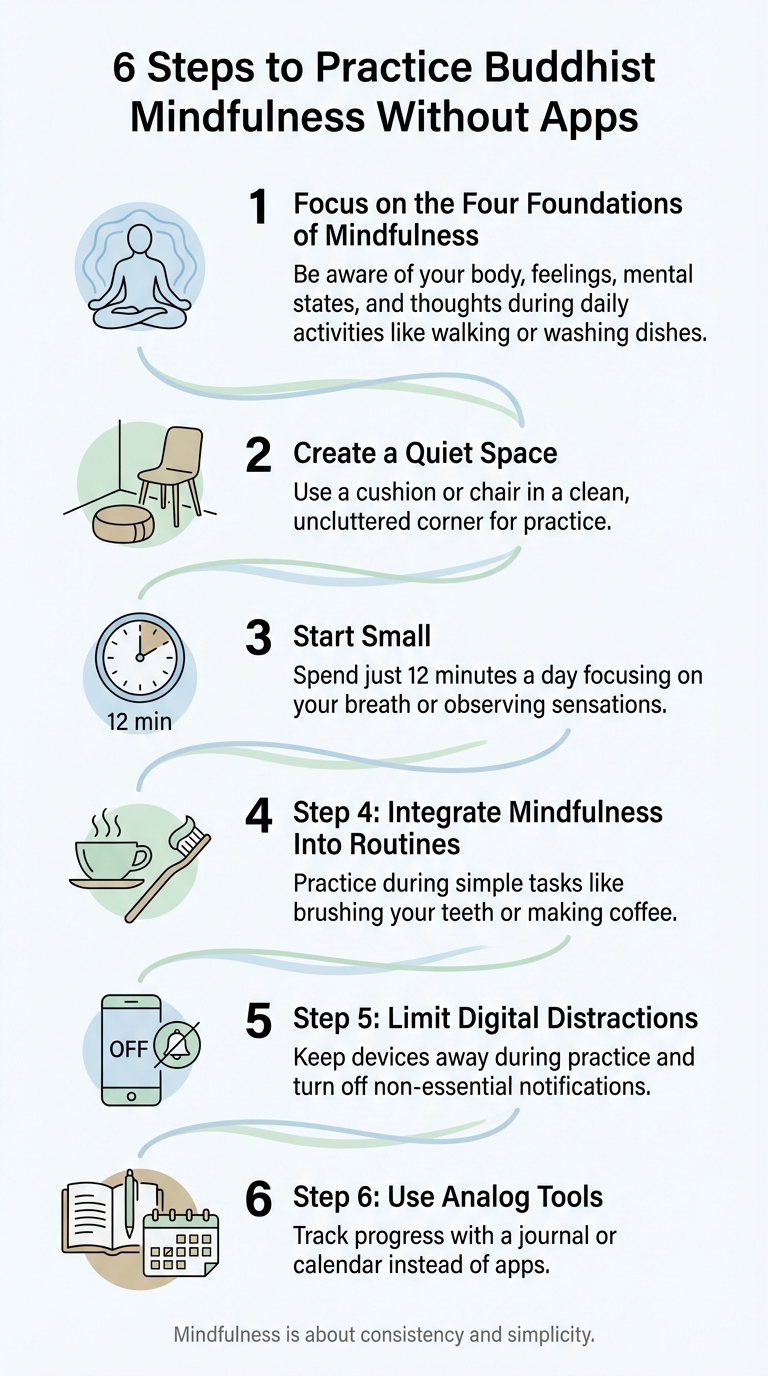
- Focus on the Four Foundations of Mindfulness: Be aware of your body, feelings, mental states, and thoughts during daily activities like walking or washing dishes.
- Create a Quiet Space: Use a cushion or chair in a clean, uncluttered corner for practice.
- Start Small: Spend just 12 minutes a day focusing on your breath or observing sensations.
- Integrate Mindfulness Into Routines: Practice during simple tasks like brushing your teeth or making coffee.
- Limit Digital Distractions: Keep devices away during practice and turn off non-essential notifications.
- Use Analog Tools: Track progress with a journal or calendar instead of apps.
Mindfulness is about consistency and simplicity. By stepping away from screens, you can cultivate a deeper presence in daily life.
Core Principles of App-Free Buddhist Mindfulness
What Sati Means: Mindfulness as Awareness
The Pali word sati translates to "memory" or "to remember" [12, 14]. In essence, it’s about maintaining focus on an object, like your breath, and gently bringing your attention back when it strays. Thanissaro Bhikkhu, Abbot of Metta Forest Monastery, explains it straightforwardly:
"What does it mean to be mindful of the breath? Something very simple: to keep the breath in mind. Keep remembering the breath each time you breathe in, each time you breathe out." [3]
This practice fosters a sense of non-reactive awareness. For instance, if you catch yourself thinking about your grocery list during a walk, you simply note the thought - "thinking" - and return your focus to the sensation of your feet meeting the ground [17, 18]. This mindful awareness serves as a foundation for broader practices, such as those outlined in the Four Foundations of Mindfulness.
The 4 Foundations of Mindfulness in Everyday Life
By following an app-free approach, the Buddha's Four Foundations of Mindfulness offer a practical framework that seamlessly integrates into daily life [4, 14].
The first foundation is body awareness - being mindful of whether you’re sitting, standing, walking, or lying down. For example, while waiting in line at the grocery store or DMV, you can focus on the feeling of your feet on the ground or the weight of your body.
The second foundation involves paying attention to feelings, categorizing each moment as pleasant, unpleasant, or neutral [4]. Whether it’s enjoying your first sip of coffee or reacting to a dog barking early in the morning, this practice helps you notice how quickly you respond to sensations.
The third foundation is about observing your mental state - whether your mind feels calm, restless, focused, or distracted [4, 14]. The fourth foundation extends this awareness to mental qualities, such as recognizing obstacles like desire, anger, or doubt as they arise [4].
These four foundations can be applied throughout the day. Instead of waiting for a dedicated meditation session, use routine activities as mindfulness cues - like brushing your teeth or washing dishes [5]. This approach highlights the simplicity and accessibility of mindfulness.
Simplicity and Repetition in Buddhist Practice
At its core, Buddhist mindfulness relies on natural anchors: your breath, posture, and the sensations of daily life [4, 16]. There's no need for guided meditations or gamified progress trackers. The Buddha described the Four Foundations as "the only way" to purify the mind and alleviate suffering [4, 14].
The power of this practice lies in repetition. When your mind wanders, you bring it back to your anchor. Over time, this act of returning becomes second nature. Traditional teachings emphasize that with consistent effort, mindfulness takes on a life of its own, arising spontaneously without the need for deliberate effort [6]. The practice remains intentionally simple, avoiding unnecessary complexities that could clutter the mind further.
Setting Up a Mindful Environment Without Apps
Creating a Basic Practice Space
You don’t need a dedicated meditation room to get started. A quiet corner with a cushion or a straight-backed chair works just fine. Zen teacher Norman Fischer sums it up perfectly:
"No place to meditate? There is always somewhere - all you need is the space for a cushion on the floor. But better to have a clean and well-cared-for spot, even if only in a corner of an otherwise busy messy room." [10]
The setup is intentionally simple. If you prefer sitting on the floor, use a cushion - known as a zafu in Zen practice - or fold a blanket for support. If a chair feels more comfortable, pick one with a straight back so your feet rest flat on the ground [11]. To give the space a sense of focus, consider adding a small table or shelf. You can place a candle, a meaningful photo, or even a small stone on it [8]. These small touches create a sense of intention without involving any screens or gadgets.
Keeping this area clean and uncluttered is part of the mindfulness practice itself [10]. Just the act of tidying up the space helps you begin cultivating awareness. The goal isn’t perfection - it’s consistency. A tidy spot also reduces the chances of digital distractions, making it easier to settle into your practice.
Managing Distractions in Your Home
Digital devices are one of the biggest obstacles to staying present. Dr. Mark Bertin offers a simple solution:
"Shut off notifications and alarms that aren't vital; we don't need to know immediately about every email, social media posting, game update, or news event." [9]
During your practice, leave your phone in another room [9]. If you need to keep track of time, opt for a wall clock or burn a stick of incense instead of relying on a phone timer [10].
The timing of your practice can also make a big difference. Early mornings, before your household wakes up or digital devices come to life, provide a natural window of calm [10]. If you share your space with others, let them know about your practice and ask for 20–30 minutes of quiet time. Once they understand that this is about cultivating mindfulness and presence, most people are happy to respect that boundary.
Adding Mindfulness to Daily Routines
Incorporating mindfulness into your daily life can be simple and rewarding, helping you stay present without relying on digital tools. These practices bring a sense of calm and awareness to your routine, grounding you in the moment.
Morning and Evening Mindfulness Routines
How you begin your morning often shapes the rest of your day. Start by taking three deep breaths as soon as you wake up and set a clear intention for the day, like "I will approach challenges with patience." You might also try Thich Nhat Hanh's "half-smile" practice - gently smiling while still lying in bed can help create a positive mindset. As you prepare to face the day, ask yourself, "How can I make the most of today?"
In the evening, create a mindful transition as you return home. Pause at your front door and engage in a simple ritual - changing into comfortable clothes or washing your hands while focusing on the temperature of the water and how it feels on your skin. Spend 5–10 minutes sitting quietly to unwind. Before bed, reflect on your day and take five slow, mindful breaths to ease into relaxation. These routines help anchor you to the present and bring a sense of balance to your daily life.
Mindful Walking and Everyday Tasks
Walking offers an easy way to practice mindfulness without any devices. Pay attention to the feeling of your feet touching the ground and the air brushing against your skin. Even routine tasks like making coffee or folding laundry can become mindful moments. Notice the sound of water pouring, the aroma of coffee grounds, or the texture of fabric in your hands. These small, intentional acts can transform mundane routines into meaningful practices.
Considering that 95% of our behavior happens on autopilot [13], turning everyday moments into mindful practices helps re-engage your focus and bring intentionality to your actions. Use these moments as gentle reminders to return to your breath.
Breath-Focused Practice Without Audio Guidance
You don’t need an app or guided audio to focus on your breath. Start by sitting comfortably with a straight but relaxed spine [11]. Rest your hands on your thighs and let your gaze naturally lower [14]. Shift your attention to the sensation of air entering your nose and the rise and fall of your chest.
It’s natural for your mind to wander during this practice. When your thoughts drift to errands or past conversations, simply acknowledge them as "thinking" and gently bring your focus back to your breath [12].
Meditation teacher Sharon Salzberg puts it beautifully:
"The most important moment in your meditation practice is the moment you sit down to do it. Because right then you're saying to yourself that you believe in change, you believe in caring for yourself, and you're making it real." [14]
Start small - just 12 minutes a day, five days a week. Research shows this can improve your ability to focus. With each breath, you’re building a foundation of mindfulness that can carry you through the rest of your day.
Using Sutta 423 for Daily Verse Reflection

Sutta 423 provides a simple and effective way to integrate Buddhist teachings into your daily mindfulness routine. It avoids overwhelming users with excessive content or complex features, offering just one verse from the Dhammapada each day. This minimalist approach allows for deeper focus, helping you reflect meaningfully without the distractions of too much information.
Using Daily Verses as a Mindfulness Anchor
In Buddhist practice, mindfulness - or sati in Pali - is described as "the ability to remember," particularly the dharma (teachings) throughout the day [18]. Start your morning by reading the daily verse, then take a moment to sit quietly, focus on your breath, and identify a phrase from the verse that resonates with you. Memorize this phrase as your mindfulness anchor for the day. Use it as a mental checkpoint during moments of transition, such as before checking emails or after stepping away from your phone [16][17].
Malcolm Huxter, a clinical psychologist and dharma teacher, explains:
"Mindfulness, or sati in Pali, is a key element of the Buddha's path to enlightenment. It's defined as the ability to remember, which in a spiritual context, means keeping in mind the dharma." [18]
With this daily anchor in place, you can begin to translate these teachings into actionable intentions for your everyday life.
Connecting Verse Reflection With Practice
To deepen your engagement, pair your daily anchor with a reflective practice: read, paraphrase, and sit quietly with the verse. After reading, dedicate 10–15 minutes to free writing about the verse. Don’t worry about grammar - focus on exploring its meaning and how it applies to your life [15]. This process encourages personal insights and fosters a deeper connection to the teaching.
Mirabai Bush, Senior Fellow at the Center for Contemplative Mind in Society, explains the impact of this method:
"Mindful reading is radically different. It slows down the reader and the reading - that alone changes the experience. It is a process of quiet reflection that requires mindful attentiveness, letting go of distracting thoughts and opinions to be fully in the moment with the text." [15]
End your session by setting a clear intention to apply the verse's teaching in your daily actions [19]. This step transforms the verse from a mere concept into a guiding principle for your life. By focusing on one teaching each day, you allow its wisdom to take root and grow over time [19].
Solving Common Problems Without Digital Tools
Working With Restlessness, Sleepiness, and Boredom
When practicing mindfulness, it’s common to encounter challenges like restlessness, sleepiness, and boredom. The key to navigating these is to approach them with awareness and curiosity [1].
Restlessness often signals excess energy. Instead of reacting, try observing the sensation. If it persists, take a break with mindful walking for five to ten minutes [20][23]. Another helpful method is the STOP technique: Stop what you’re doing, Take a breath, Observe your thoughts and feelings, and Proceed mindfully [22]. For quick relief, you can also try progressive muscle relaxation - squeezing and releasing muscle groups from your toes to your face to channel that energy [23].
Sleepiness can often be addressed by adjusting your posture. Bhante Gunaratana suggests sitting upright with a balanced posture to stay alert [24][1]. If drowsiness lingers, open your eyes and focus on something external, like the movement of leaves or patterns of light, to break the mental fog [21].
Boredom is usually a sign that you’ve drifted away from the present moment [20]. To counter it, pinpoint its physical sensations and the thoughts tied to it. Then, try the Five Senses exercise: notice five things you see, four things you feel, three you hear, two you smell, and one you taste [21][23]. This simple practice pulls you back into the moment without needing any digital assistance.
By addressing these obstacles mindfully, you strengthen your ability to stay present and deepen your practice. These techniques also prepare you to track your progress without relying on digital tools.
Tracking Progress With Analog Methods
Tracking your mindfulness journey doesn’t require apps or gadgets. Simple analog methods can be just as effective. Meditation teacher Sharon Salzberg highlights the importance of simply showing up:
"One of my meditation teachers said that the most important moment in your meditation practice is the moment you sit down to do it. Because right then you're saying to yourself that you believe in change..." [14]
You can mark your practice days on a calendar or jot down quick notes in a journal [17][7]. Write about your experience - whether your mind felt restless, calm, or distracted. This allows you to notice patterns over time without the distractions of digital tracking [7][26]. Studies show that practicing for just 12 minutes a day, five days a week, can significantly improve your ability to focus [14].
Bhante Gunaratana offers a simple measure of progress:
"If your mindfulness leads to reducing your greed, hatred, and delusion, it is right mindfulness, and every minute of this practice is beneficial." [25]
Progress isn’t about how long you sit or how many days you log - it’s about the quality of awareness you bring to your daily life. Use a kitchen timer to set your sessions for 5, 10, or even 45 minutes, so you’re not tempted to check your phone [14]. Commit to practicing daily, even for just five minutes, to build consistency without relying on digital reminders [14].
Conclusion
Practicing Buddhist mindfulness without relying on apps isn't about turning your back on technology - it’s about reclaiming your focus and cultivating a deeper sense of presence. By stepping away from screens, you shift from what one teacher describes as "restless distraction" to a far more fulfilling way of being [2].
When you strip away the digital noise, you create space for a more genuine and undisturbed practice. The beauty of practicing mindfulness without apps lies in its simplicity. All it takes is your attention - whether it’s following your breath, walking with awareness, or simply observing your own restlessness. As Christina Feldman, co-founder of Bodhi College, explains:
"Mindfulness is not something we do. Rather, there are various contemplative trainings that we undertake... to bring this capacity and quality of mindfulness into the forefront of consciousness" [27].
The ability to practice is already within you - just return to it. These simple practices are a reminder that mindfulness flourishes in simplicity.
For those looking for a minimalistic approach, Sutta 423 offers a gentle alternative. It provides one verse from the Dhammapada each day, without the clutter of feeds, notifications, or endless scrolling. Its design encourages less reading and deeper reflection, giving you a single teaching to contemplate.
Start small. Spend five minutes on mindful breathing or engage in a short mindful activity. These small, consistent efforts can lead to meaningful growth, as emphasized in the Satipatthana Sutta [1]. You don’t need an app to remind you - just take the first step.
FAQs
How can I practice mindfulness without relying on meditation apps?
Practicing mindfulness without relying on apps can be both straightforward and fulfilling. Begin by weaving small, intentional moments of awareness into your daily life. For instance, when you wake up, take a few deep, mindful breaths, paying attention to how the air feels as it enters and leaves your body. While walking, focus on the rhythm of your steps or the feeling of the ground under your feet. During meals, take time to truly savor the flavors, textures, and aromas of your food.
Another simple technique is a quick body scan - mentally check in with different parts of your body, noticing any tension or sensations. You can also pause throughout the day to observe the sounds, sights, and smells in your surroundings. These small, accessible practices can help you cultivate a sense of presence and awareness, no matter where you are.
What are the Four Foundations of Mindfulness, and how can I use them in daily life?
The Four Foundations of Mindfulness - mindfulness of the body, feelings, mind, and mental objects (dhammas) - are rooted in Buddhist teachings and offer a practical way to develop awareness and insight. These practices encourage us to observe our experiences clearly and without judgment, helping us stay connected to the present moment.
Here’s how you can incorporate these foundations into your daily life:
- Body: Focus on physical sensations, like the rhythm of your breath, your posture, or the feeling of warm water as you wash dishes.
- Feelings: Pay attention to whether an experience feels pleasant, unpleasant, or neutral. Instead of reacting, try to simply acknowledge the feeling without clinging to it or pushing it away.
- Mind: Notice your thoughts and emotions as they come and go. You might gently label them - "thinking", "worrying", or "planning" - to create space between you and the mental activity.
- Mental objects: Contemplate ideas like impermanence in everyday situations. For example, observe how a sunset fades into night or how a traffic light changes from red to green.
By weaving mindfulness into ordinary tasks, you can turn even the simplest moments into opportunities for calm, clarity, and a deeper sense of self-awareness.
How can I stay focused during mindfulness practice without using apps or digital tools?
Staying focused during mindfulness practice doesn’t require any gadgets or apps - it’s about honing your natural ability to stay in the moment. Begin by simply noticing when your thoughts drift. Maybe it’s a noise, a random idea, or that itch to grab your phone. When this happens, try keeping a small tally on a piece of paper. This quick action creates a moment of awareness, giving you the chance to gently guide your attention back to the present.
To make this easier, set yourself up in a distraction-free environment. Keep your phone out of sight - better yet, in another room - and find a quiet, cozy spot where interruptions are less likely. Studies have shown that just removing your phone from view can significantly reduce the urge to check it.
You can also deepen your mindfulness practice by drawing inspiration from the Satipaṭṭhāna Sutta, a teaching that emphasizes observing your body, emotions, thoughts, and mental habits. This perspective can turn simple, everyday activities - like walking or doing the dishes - into mindful moments. By combining these methods, you can sharpen your focus and enjoy a more grounded mindfulness practice, no tech required.
Related reading
- How to Read the Dhammapada: A Beginner's Practice Guide
- One Verse a Day: Why Less Buddhist Reading Leads to Deeper Practice
- Dhammapada verses explained
- Best Free Buddhist Apps for iPhone in 2026 (No Subscriptions)
- Morning Buddhist Practice: 5-Minute Routines for Busy Professionals
Useful tools & services
A small daily scripture practice
Sutta 423 is our app for reflecting on one Dhammapada verse each day. Explore how it works and whether it suits your practice.
Explore Sutta 423These are products built by Artisan Strategies.